Versele Laga Nutribird A19 Supplement for Birds
Final price depends on the options you choose.
Nutribird A19 Hand Feeding Formula for Baby Birds
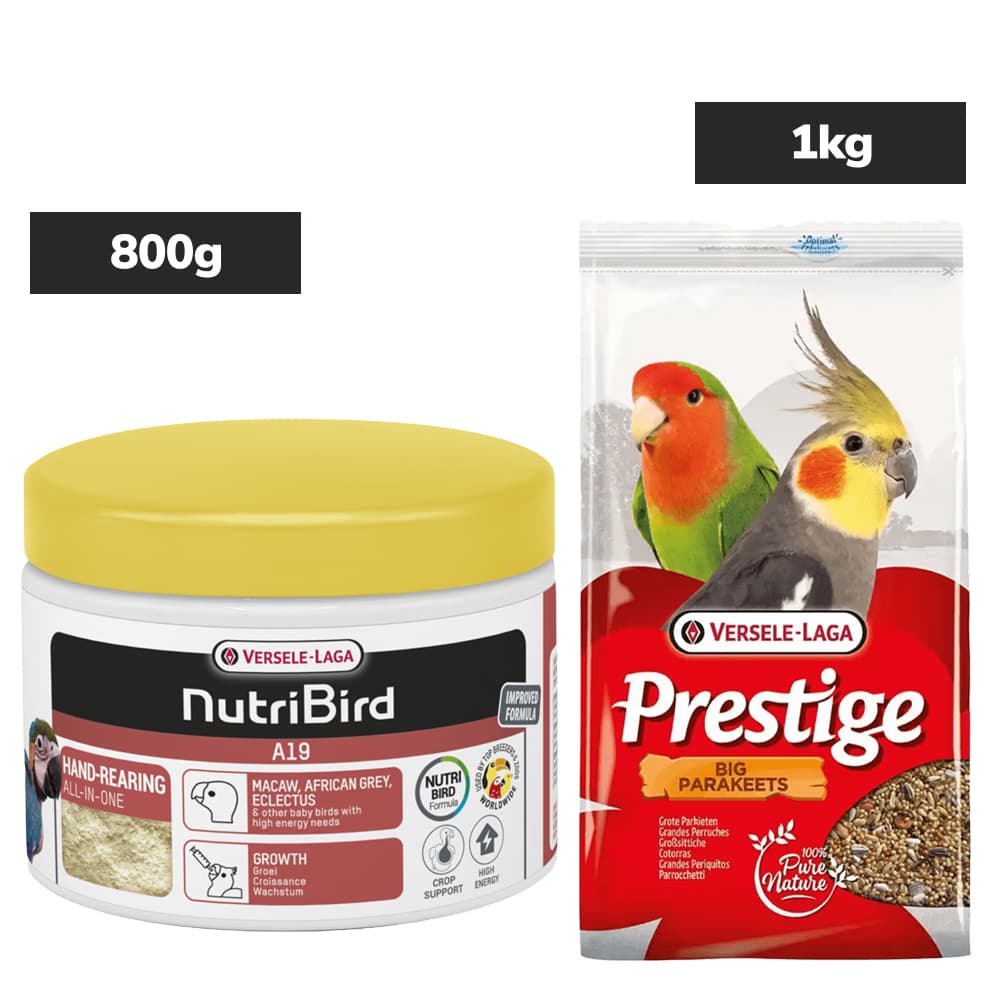
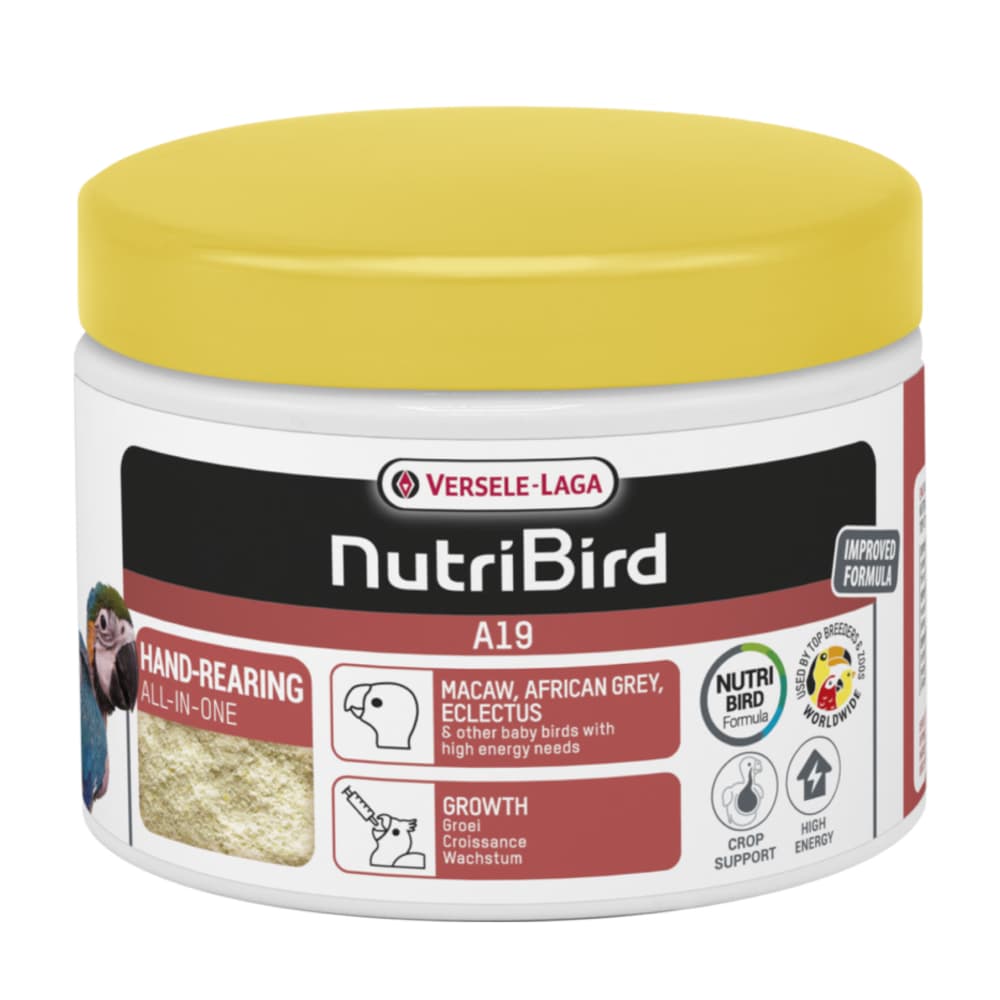
Nutribird A19 by Versele Laga is a complete hand feeding formula built for baby birds with high energy needs, from hatching right through to weaning. Whether you're hand-rearing a macaw chick, an African grey, or an eclectus parrot, this Versele Laga Nutribird A19 formula gives you a single, balanced A19 bird food you can mix and feed by syringe at every growth stage. It's available on Supertails in 250g and 800g packs.
What Nutribird A19 is and how it works
Nutribird A19 is a hand feeding formula for baby birds, formulated by Versele Laga specifically for chicks with a high energy requirement — think macaws, African greys, eclectus parrots and hawk-headed parrots. As a bird hand rearing formula, it's built to replace the crop-feeding a parent bird would normally provide, giving chicks the calories and nutrients they need while their digestive system is still developing.
The formula is made from bakery products, vegetable protein extracts, oils and fats, vegetable-origin derivatives, minerals, sugars and yeasts, with added gut-flora stabilisers: organic acids, psyllium and mannan-oligosaccharide prebiotics, plus digestive enzymes and lecithin. Together, these support a young bird's gut health at exactly the stage it's most vulnerable — which is why this bird chick feeding formula is trusted by breeders and bird parents across the hand-rearing period.
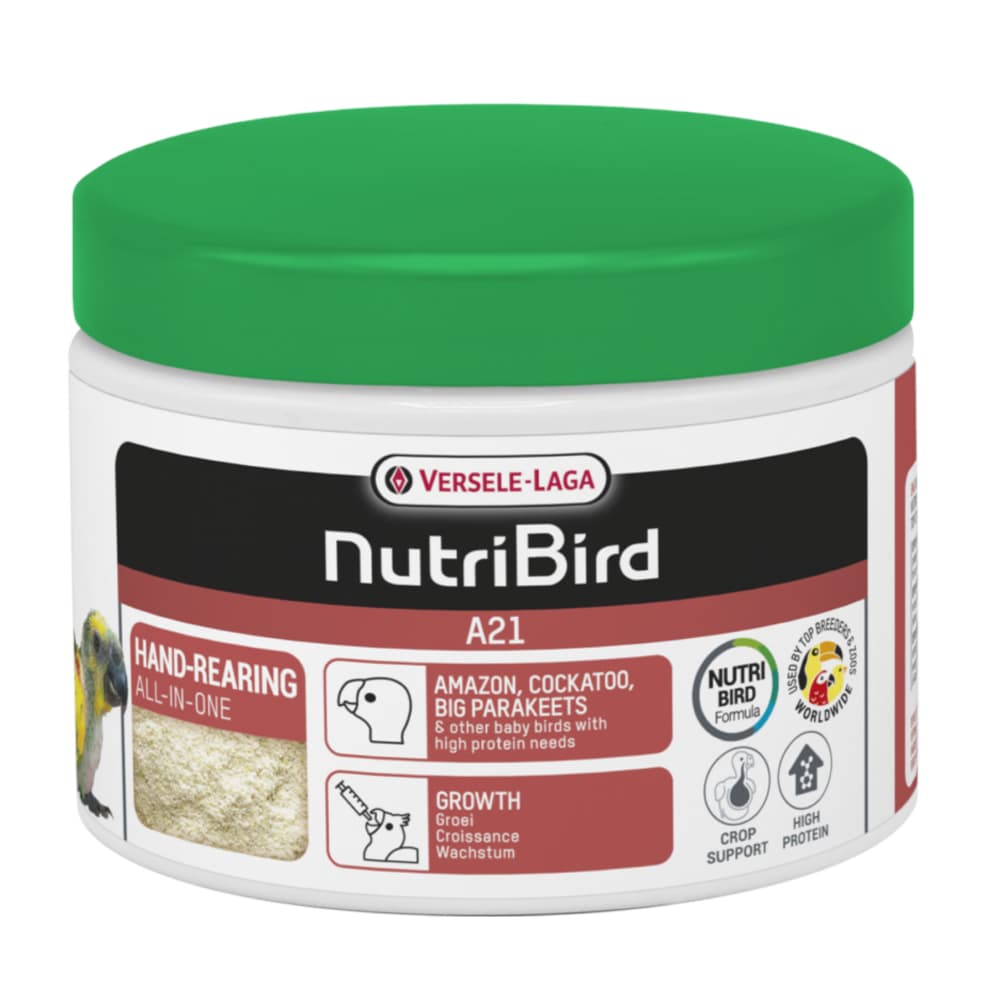
One thing worth clearing up: Nutribird A19 vs A21 aren't interchangeable. A19 is built for birds with a high energy requirement (macaws, African greys, eclectus, hawk-headed parrots), while A21 is built for birds with a high protein requirement (amazons, cockatoos, large parakeets). If you're not sure which your chick needs, check with your breeder or an avian vet before you start.
Analytical Constituents
Protein 19%, fat content 15%, crude ash 9.5%, crude fibre 1.5%, lysine 1.1%, methionine 0.6%, tryptophan 0.23%, threonine 0.7%, calcium 1.15%, phosphorus 0.8%, sodium 0.35%, magnesium 0.12%
Additives/Kg
Vitamin A 7200 IU, 3a160a β-carotene 4.35 mg, vitamin D3 1500 IU, vitamin E 85 mg, vitamin B1 7.2 mg, vitamin B2 16 mg, calcium-D-pantothenate 20 mg, vitamin B6 6 mg, vitamin B12 0.03 mg, vitamin C 52 mg, niacin 80 mg, folic acid 1.5 mg, biotin 0.26 mg, choline chloride 700 mg, 3b202 (iodine) 2 mg, 3b405 (copper) 10 mg, 3b503 (manganese) 100 mg, 3b605 (zinc) 96 mg, 3b802 (selenium) 0.1 mg, 3b811 (organic selenium) 0.1 mg
Zoo Technical Additives
Bacillus subtilis C-3102 (DSM 15544) 22.10 8 CFU, endo-1,4-β-xylanase (EC 3.2.1.8) 3000 EPU
Technical Additives
Antioxidants
Feeding guide — how to prepare and use Nutribird A19
This is a hand feeding food for baby birds, mixed fresh for every feed — never pre-mixed and stored. Here's how to prepare it:
- Mix the Nutribird A19 powder with warm water (not boiling), stirring until smooth and lump-free.
- Use only boiled-and-cooled water or bottled water — untreated tap water can carry bacteria a young chick's system can't handle yet.
- Feed roughly 10% of the chick's body weight per feeding session, adjusting as the chick grows.
- Feed using a syringe or a feeding tube, going slowly so the chick can swallow comfortably.
The water-to-formula ratio changes as the chick grows, since younger chicks need a thinner, more diluted mix:
| Chick's age | Formula : Water ratio |
|---|---|
| Hatching – Day 2 | 1 : 6 |
| Day 2 – Day 3 | 1 : 5 |
| Day 3 – Day 4 | 1 : 4 |
| Day 4 – Day 5 | 1 : 3 |
| Day 5 – weaning | 1 : 2 to 1 : 2.5 |
As the chick approaches weaning, the mix gets progressively thicker, mirroring how it would naturally start moving toward solid food. Nutribird A19 can also be used for adult birds that are hand-tame, or for sick and recuperating birds that need extra support.
Vet tip: If a chick isn't finishing its usual portion or the crop feels slow to empty between feeds, that's worth a call to an avian vet rather than just feeding more at the next session.
What if a chick misses a feeding?
Young chicks need frequent, consistent feeds, so a missed feeding isn't something to just skip and move on from:
- If it's been missed by an hour or two, feed as soon as you notice, at the normal portion — don't double up to "catch up."
- If a very young chick has gone several hours without a feed, or seems weak, cold, or unresponsive, contact an avian vet before resuming feeding — a chilled or dehydrated chick may need warming and rehydration first.
- Keep a simple feeding log (time, amount) in the early weeks — it makes it much easier to spot a pattern if feeds are being missed or refused.
Safety information
- Always mix fresh for each feeding — Nutribird A19 is not meant to be prepared in advance and refrigerated for later use.
- Use only warm (not hot) water, and boiled-and-cooled or bottled water rather than untreated tap water.
- This is a hand feeding formula for chicks and recuperating/hand-tame adult birds — it is not a general daily maintenance diet for a healthy adult bird.
- Watch for slow crop emptying, regurgitation, or a chick going off its feed — these are reasons to check in with an avian vet rather than adjusting the formula yourself.
Storage
Store Nutribird A19 in a cool, dry place, away from direct sunlight and away from Indian monsoon humidity, which can cause powder formulas to clump or spoil faster than expected. Reseal the pack tightly after every use, and use within the manufacturer's stated shelf life once opened — don't keep an opened pack much beyond a couple of months in humid conditions.
Substitutes & alternatives
- Versele Laga A21 Nutri Bird Food — the high-protein counterpart to A19, better suited to amazons, cockatoos and large parakeets rather than high-energy species.
- Versele Laga Prestige Food For Parrots — a seed-and-pellet maintenance diet for weaned adult parrots, once your bird has moved past hand feeding.
- Versele Laga Prestige Food For Big Parakeets — a maintenance diet option for large parakeets post-weaning.
- Pets Empire Feeding Bottle for Birds — a feeding accessory that pairs with hand feeding formulas like Nutribird A19.
Quick tips
- Mix fresh every feed — never store premixed formula.
- Use the age-based water ratio chart; don't eyeball it.
- Feed roughly 10% of body weight per session.
- Use boiled-cooled or bottled water only.
- Track feeding times and amounts in the early weeks.
Why buy Nutribird A19 from Supertails
100% genuine Versele Laga stock, sourced through authorised channels — not something to risk with an unverified seller when a chick's nutrition is on the line. Fast delivery across India, with free shipping on orders above ₹699. If you're unsure which pack size or feeding schedule fits your chick, Supertails' vet team is available for a quick online consultation before you start.
Frequently asked questions
What is Nutribird A19 used for?
It's a hand feeding formula used to hand-rear baby birds — mainly high-energy-requirement species like macaws, African greys and eclectus parrots — from hatching until they're weaned onto solid food.
How do you prepare Nutribird A19?
Mix the powder with warm, boiled-and-cooled or bottled water, following the age-based ratio (thinner for very young chicks, thicker as they near weaning), and feed fresh by syringe or feeding tube.
Is Nutribird A19 good for baby birds, and which birds can eat it?
Yes — it's formulated specifically for baby birds with a high energy requirement, including macaws, African greys, eclectus parrots and hawk-headed parrots. It can also be used for hand-tame or recuperating adult birds.
What is the difference between Nutribird A19 and A21?
A19 is built for high-energy-requirement birds (macaws, African greys, eclectus); A21 is built for high-protein-requirement birds (amazons, cockatoos, large parakeets). Check with your breeder or vet if you're unsure which fits your chick.
How often should baby birds be hand fed, and what age can they use Nutribird A19?
Very young chicks need multiple feeds a day, tapering off as they grow and approach weaning. Nutribird A19 is designed to be used from hatching straight through to weaning, with the water ratio adjusted as the chick ages.
How should Nutribird A19 be stored, and how long does it last after opening?
Store in a cool, dry place away from direct sunlight and humidity, tightly resealed after each use. In India's climate, it's best used within a couple of months of opening rather than stored long-term.
Which pack size should I buy — 250g or 800g?
The 250g pack suits a single chick or a short hand-rearing period; the 800g pack works out better value if you're hand-rearing multiple chicks or over a longer stretch, since larger packs cost less per gram.
Order Nutribird A19 hand feeding formula online in 250g (₹855) or 800g (₹2,228) — genuine Versele Laga stock, delivered fast across India
- SKU
- SBRFT0009VE
- Brand
- Versele Laga
- Category
- Birds
- Size
- 800g, 250g
Here is how delivery and returns work at Pakhir Bazar.
Delivery
We deliver anywhere in Bangladesh. Orders are usually handed to the courier within one working day. Inside Dhaka that means delivery in 1-2 days, and 2-4 days elsewhere.
You can pay cash when the parcel reaches you, or pay online in advance.
Returns and exchanges
If a product arrives damaged, faulty, or it is not what you ordered, tell us within 7 days of delivery. We will exchange it or refund you, and the return delivery charge is on us.
Changed your mind? You can still send the product back within 7 days, as long as it is unused and in its original packaging. In that case the return delivery charge is yours.
A few products cannot be returned once opened, for hygiene or safety reasons. Where that applies, it is written on the product page.
Before you order
Check the size, colour and specifications above. If anything is unclear, message us first - we would much rather answer a question than put you through a return.